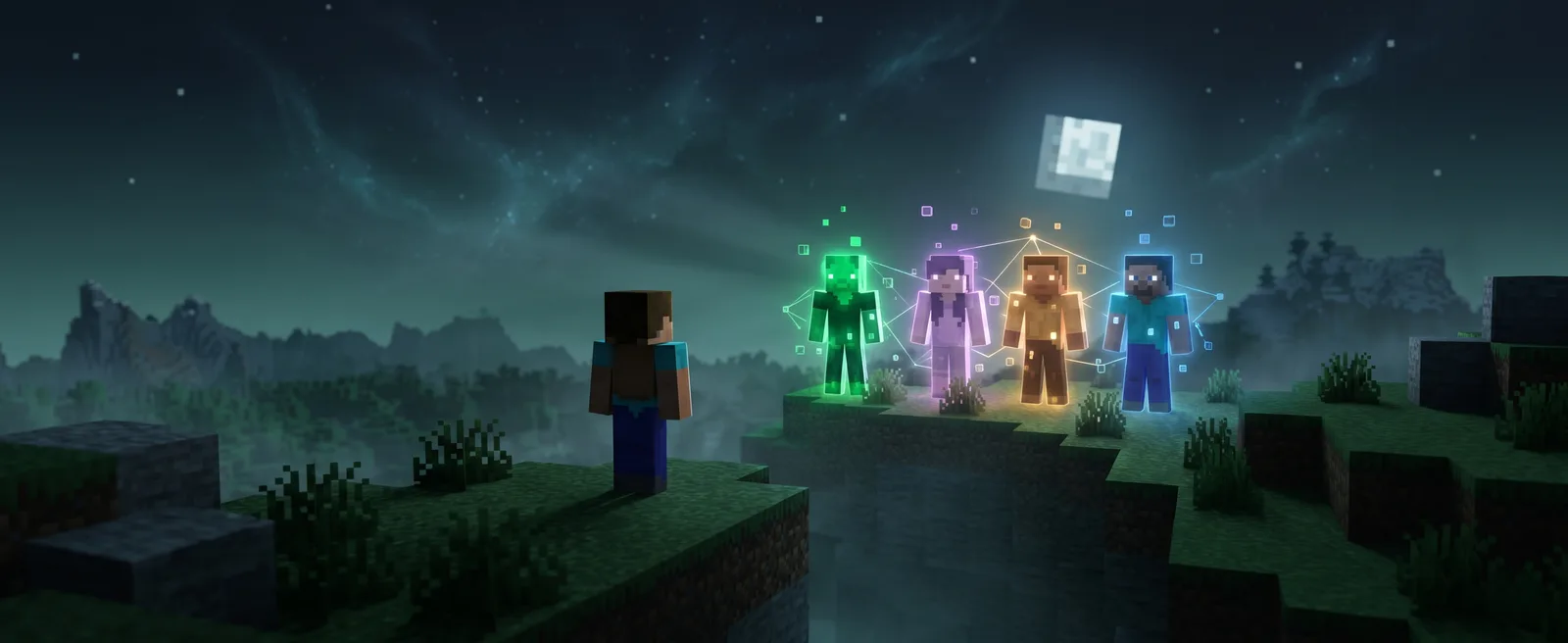
The Best AI Companion Mods for Minecraft (2026)
Four ways to put a thinking AI into your world — and how to pick the one that fits you.
The short answer
If you want an AI companion in Minecraft and you don't want to manage API keys, host infrastructure, or debug crashes, VoxelMind is the easiest way in — it's a CurseForge mod that works in singleplayer with no setup. If you're a developer who wants full control of the model and the code, Mindcraft is the most flexible open-source option. The others sit between those two poles.
That's the executive summary. Here's the honest, detailed version.
What "AI companion" actually means
The term gets used loosely, so let's be precise. An AI companion mod isn't a scripted NPC with a dialogue tree. It's a bot whose decisions are made by a large language model in real time — it perceives the world, reasons about what it sees, and picks an action. The good ones have memory, so they don't reset every time you reload. The best ones develop a personality that changes based on what happens to them.
All four mods below clear the basic bar: a real LLM drives the behavior. Where they differ is everything around that — setup cost, memory, personality depth, and who's expected to keep the lights on.
VoxelMind
Best for: players who want a companion that just works, with no technical setup.
VoxelMind is a Fabric mod for Minecraft 1.21.4–1.21.8. You install it from CurseForge, press V in-game, pick a personality, and spawn a companion. There's no API key to create, no infrastructure to host — the AI runs on VoxelMind's servers, and the mod opens a secure tunnel so even a singleplayer world works without port forwarding.
The companion has a deep toolset (mining, building, crafting, smelting, fishing, farming, combat, exploring, conversation, and more) and decides what to do autonomously. Two things set it apart: a persistent three-store memory — a spatial map, an event history, and learned facts that survive across sessions — and a continuous personality model based on the OCEAN traits from psychology, which drifts over time based on the companion's experiences. The pitch, in one line: your companion remembers how you treat it.
The trade-off: it's a hosted service, so you're trusting someone else's servers, and it's in public alpha — you'll meet rough edges. But for "I just want an AI friend in my world tonight," nothing else is this short a path. More on how Companion Mode works →
Mindcraft
Best for: developers who want full control of the model, the prompts, and the code.
Mindcraft is the well-known open-source project in this space. It's built on Mineflayer, it's free, and it's flexible — you can point it at different LLM providers, edit the prompts, and modify the behavior however you like. If you enjoy tinkering, it's genuinely fun.
The cost is setup. You bring your own API key, you run it yourself, and when something breaks, the someone who debugs it is you. That's not a criticism — it's the deal with open source. It just means Mindcraft is a tool for people who want to build, not a product for people who want to play.
MinePal
Best for: players who want an open-source companion with a friendlier on-ramp than Mindcraft.
MinePal sits in the middle. It's open-source and companion-focused, with more packaging around it than a raw framework — so the setup is gentler. You're still closer to the "configure it yourself" end of the spectrum than the "press V and play" end, and memory and personality depth vary by version. If you like the open-source ethos but don't want to assemble everything from parts, it's worth a look.
Player2
Best for: people exploring the broader category of AI agents in games.
Player2 is part of the wider wave of LLM-agent gaming projects. It's free and worth knowing about if you're surveying the landscape, but it's less narrowly a "Minecraft companion you live with day to day" than the others — treat it as a different point on the map rather than a direct swap for VoxelMind or MinePal.
How to choose
Strip away the brand names and it comes down to one question: how much setup are you willing to do?
- None. You want to play tonight, no keys, no hosting. → VoxelMind.
- Some, and you like open source. You'll configure things but want a companion-shaped product. → MinePal.
- All of it, because the tinkering is the point. You want to own the model and the code. → Mindcraft.
- You're just exploring the category. → Try a couple, including Player2, and see what clicks.
The second question is memory. A companion without persistent memory is a chatbot with a skin — it can't grow, can't hold a grudge, can't become yours. If that's the part you care about, weigh it heavily. It's the part VoxelMind is built around.
Try VoxelMind
If the no-setup path is the one you want, VoxelMind is on CurseForge now and free during the alpha. The next post walks through the full install, step by step: How to Add an AI Companion to Minecraft →
Or come argue with us about this list in Discord — we'd rather be on it honestly than not on it at all.
Try VoxelMind free
An AI companion that remembers you — free to play, no setup beyond the Fabric mod.