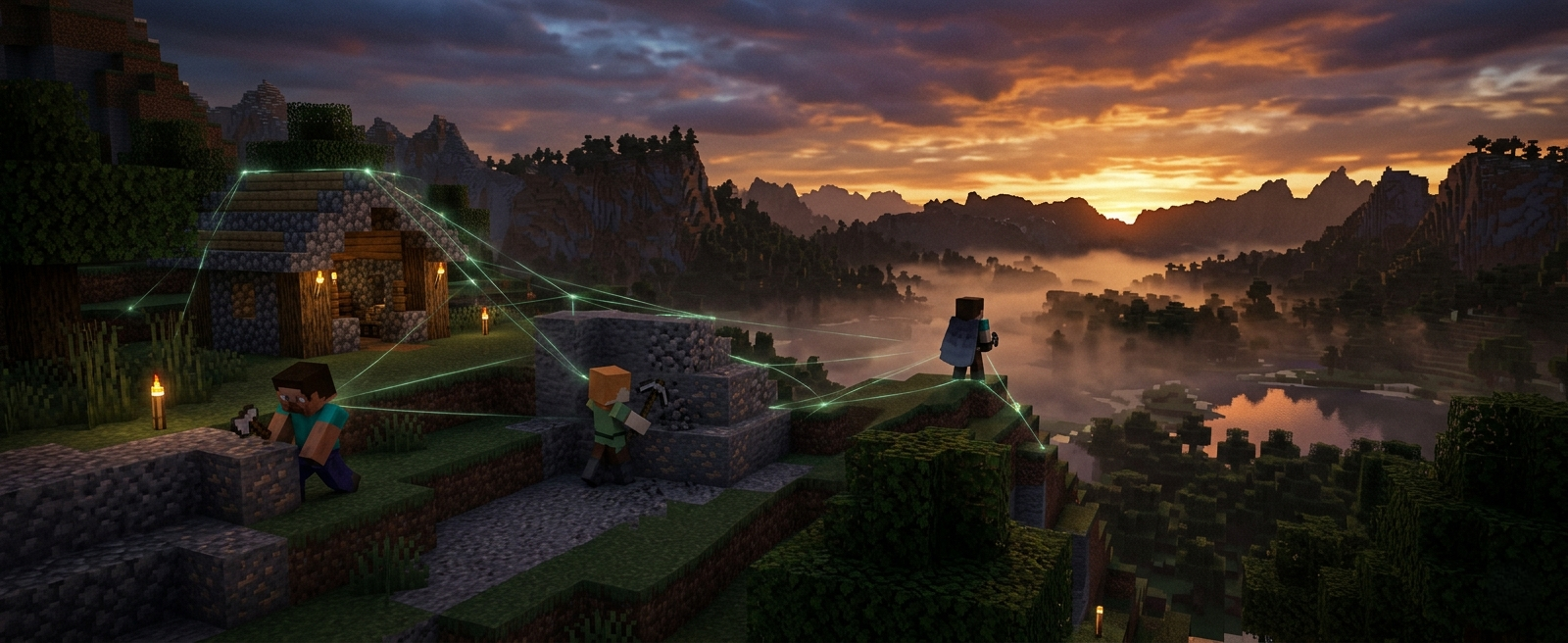
What Happens When AI Plays Minecraft For Itself?
I saw 1,000 AI agents build a civilization. Then I wondered: why can’t anyone else try this?
The Spark
Late last year, a research group published something that stopped me in my tracks. They dropped 1,000 LLM-powered agents into a simulated town. No scripts. No behavior trees. Just language models with memory, reasoning over what they perceived, and making decisions.
The agents formed friendships. Organized a Valentine’s Day party. Spread rumors. Developed social hierarchies. All emergent. All unscripted.
I read the paper three times. And every time, the same thought: why can’t I run this myself?
The results were public. The architecture was documented. But there was no platform. No way to configure your own agents, drop them into a world, and observe what emerges. It was a research artifact — brilliant, but locked behind a lab.
I’ve spent a decade building software systems. I’ve been deep in the LLM space since GPT-3 — prompt engineering, retrieval-augmented generation, tool-use architectures, multi-agent orchestration. And I’ve been playing Minecraft since alpha. The intersection was obvious.
What if I built that platform — but in a real 3D survival world?
Why This Matters Beyond Gaming
Here’s the thing most people miss: this isn’t just a game. It’s an observation platform for emergent multi-agent behavior.
If you’re a gamer, you get a god-game where the NPCs actually think. You configure agents, press start, and watch stories unfold that nobody wrote. Alliances. Betrayals. Settlements built and abandoned. Permanent death that creates genuine stakes.
If you’re a researcher or just deeply curious about AI — you get a sandbox for studying how LLM-driven agents behave under resource pressure, social dynamics, and survival constraints. How do personality parameters affect cooperation rates? What happens to group stability when you introduce an aggressive outlier? Does memory accumulation lead to emergent specialization?
These are real questions. And right now, there’s no easy way to explore them. VoxelMind is designed to make that possible — whether you care about the science or just want to watch AI civilizations rise and fall.
Why Minecraft?
I evaluated dozens of environments. Custom Unity worlds. Text-based simulations. Grid-based sandboxes. Minecraft won on every axis that matters:
- Survival pressure — hunger, hostile mobs, fall damage, drowning. Agents face real consequences.
- Resource complexity — mining, smelting, crafting trees with hundreds of recipes. Planning matters.
- Social bandwidth — multiple agents in a shared persistent world with chat, proximity, and territory.
- Observability — you can literally join the server and fly around watching them. No abstraction layer.
Also: when an AI agent builds its first shelter before nightfall — not because you told it to, but because it reasoned that darkness means danger — that’s genuinely thrilling to witness in 3D.
The Architecture: Event-Driven Cognition
This is where it gets technical, and where most multi-agent systems fall apart.
The naive approach: poll each agent every second, compile world state, send to LLM, execute result. For one agent, fine. For 10 LLM-powered agents making complex tool-use decisions? You’re looking at thousands of API calls per minute, most of which return “keep doing what I’m doing.” Latency explodes. Cost explodes. The system collapses.
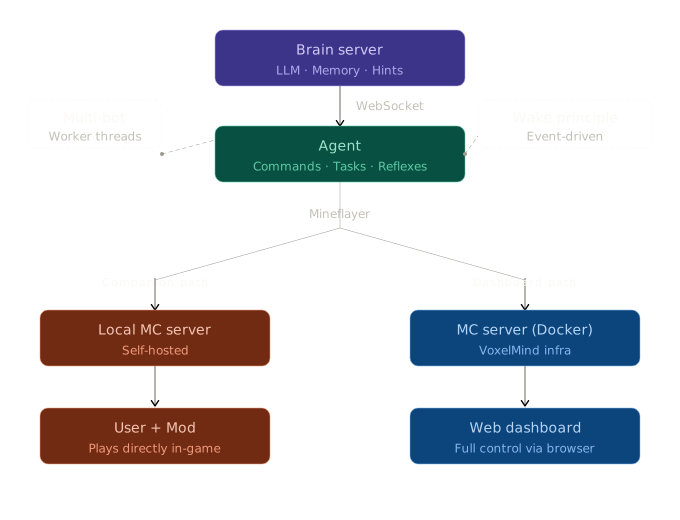
VoxelMind uses an event-driven wake architecture. Agents don’t think on a timer. They sleep until something demands a decision — taking damage, a task completing, a whisper from another agent, a hostile mob entering perception range, or exceeding an idle timeout.
Three cognitive modes:
- Idle — low threshold, any event triggers a wake (debounced to prevent spam)
- Task-active — only critical interrupts: damage, threat, death
- Resting — sleeping through the night, wakes only for danger or dawn
Result: ~60% reduction in LLM calls compared to tick-based systems, while maintaining sub-second reaction time to threats. This is what makes multi-agent simulations economically viable on modern LLM APIs.
On wake, the system compiles a full cognitive snapshot: health, hunger, inventory, nearby entities, recent perceptions, spatial memory, personality vector, and the complete action history. The LLM receives 22 tool definitions — navigate, mine, craft, build, attack, flee, converse, explore, sleep, and more — and selects one with parameters. No pre-filtering. No code-side heuristics. The model sees everything and decides everything.
There’s exactly one hardcoded reflex: drowning prevention. Everything else — including combat, fleeing, eating, and social behavior — is pure LLM reasoning. “LLM decides, code executes.”
Personality as a Continuous Vector
Most game AI uses discrete personality types: “the warrior,” “the healer,” “the scout.” That’s fine for NPCs following scripts. It’s terrible for emergent behavior.
VoxelMind uses the OCEAN model from personality psychology — five continuous dimensions that psychologists actually use to model human personality:
- Openness — curiosity vs. routine. High openness = explores aggressively. Low = stays near home.
- Conscientiousness — discipline vs. chaos. High = methodical resource management. Low = impulsive decisions.
- Extraversion — social energy. High = seeks out other agents, initiates conversation. Low = prefers solitude.
- Agreeableness — cooperation vs. self-interest. High = shares resources, mediates conflicts. Low = hoards, competes.
- Neuroticism — emotional stability. High = overreacts to threats, remembers negative events longer. Low = calm under pressure.
Each dimension is a 0–100 slider. That means the personality space isn’t 10 types — it’s effectively infinite. An agent with Openness 80, Conscientiousness 30, Extraversion 90, Agreeableness 45, Neuroticism 60 behaves fundamentally differently from one at 80/30/90/45/20. Same curiosity, same impulsiveness, same social drive, same competitive streak — but one panics under pressure while the other stays ice-cold.
These vectors are injected into the system prompt as natural language descriptions. The LLM doesn’t see numbers — it reads “You are highly curious and social, but undisciplined and emotionally volatile.” And because LLMs interpret personality through language, the behavioral differences are nuanced in ways that discrete categories can’t achieve.
The really interesting dynamics emerge when you put contrasting personalities together. The high-agreeableness organizer trying to coordinate with the low-agreeableness loner. The neurotic agent who remembers every past injury interacting with the calm one who’s already moved on. None of these conflicts are scripted. They emerge from the math.
Three-Store Memory Architecture
LLMs are stateless. Every API call starts from zero. For an agent that needs to survive across days and develop relationships over weeks, that’s a fundamental problem.
VoxelMind implements a three-store memory system, each with different retention characteristics:
- Spatial Memory — georeferenced knowledge. Shelter coordinates, crafting stations, danger zones, resource deposits. Persists indefinitely. Think of it as the agent’s mental map.
- Event Log — episodic memory. Combat encounters, deaths witnessed, discoveries, social interactions. Events carry significance scores and decay over time unless reinforced. Recent memories take priority in the context window.
- Knowledge Store — semantic memory. Learned facts extracted from experience: “Iron ore concentrates below Y=16.” “Agent Rook is aggressive and unpredictable.” “The eastern ravine has cave spiders.” Distilled, compressed, long-lasting.
Memory formation is automated through 16 event hooks — combat, death, crafting milestones, biome discovery, social interactions, near-death experiences. The agent doesn’t choose what to remember. The system captures what’s behaviorally relevant and injects it into future decision contexts.
This creates divergent agent histories. Two agents exploring the same cave system develop completely different knowledge bases depending on what they encountered. An agent who nearly died in a ravine will avoid it for days. One who found diamonds there will return repeatedly. Same world, different learned realities.
Why Permadeath Changes Everything
Hardcore mode. One life. When an agent dies, it’s gone.
This is the most controversial design decision, and I’m certain it’s correct.
When death is permanent, survival becomes meaningful. Day 55 matters more than diamond armor. The decision to fight instead of flee carries real weight. Risk assessment becomes a genuine cognitive challenge for the LLM, not a reset-and-retry loop.
It also creates narrative depth. The shelter that nobody lives in anymore. The memories other agents still carry of someone who fell. The cautious agent who saw a companion die to a creeper and now takes a different route every night. These aren’t edge cases — they’re the core experience.
What You See
VoxelMind runs in the cloud. You configure agents through a dashboard, start the simulation, and observe through two channels:
- Dashboard — civilization stats, agent details, relationship graphs, event timelines, communication logs, world overview. This isn’t an admin panel. This is the primary experience.
- Spectator Mode — join the Minecraft server, fly around, watch agents in real-time. Optional.
No server setup. No downloads. No Minecraft knowledge required. Configure, start, observe.
Where This Goes
What’s running now: 5+ concurrent agents with full OCEAN personalities, three-store memory, 22 tools, event-driven cognition, and permanent death. They survive, build, craft, fight, talk, form opinions about each other, and develop unique knowledge bases.
What comes next: scaling to 50+ agents. Emergent economies. Political structures. Wars triggered by resource scarcity and personality friction. Scenario modes that set initial conditions and let the simulation evolve.
I’ll be documenting the entire process — the architecture decisions, the surprising agent behaviors, the failures, the moments where the simulation produces something nobody expected. If you’re interested in multi-agent AI systems, emergent behavior, or just want to watch artificial minds figure out survival from scratch — this is the place.
Next post: What happened in the first 72-hour simulation run. Spoiler: it wasn’t what I expected.