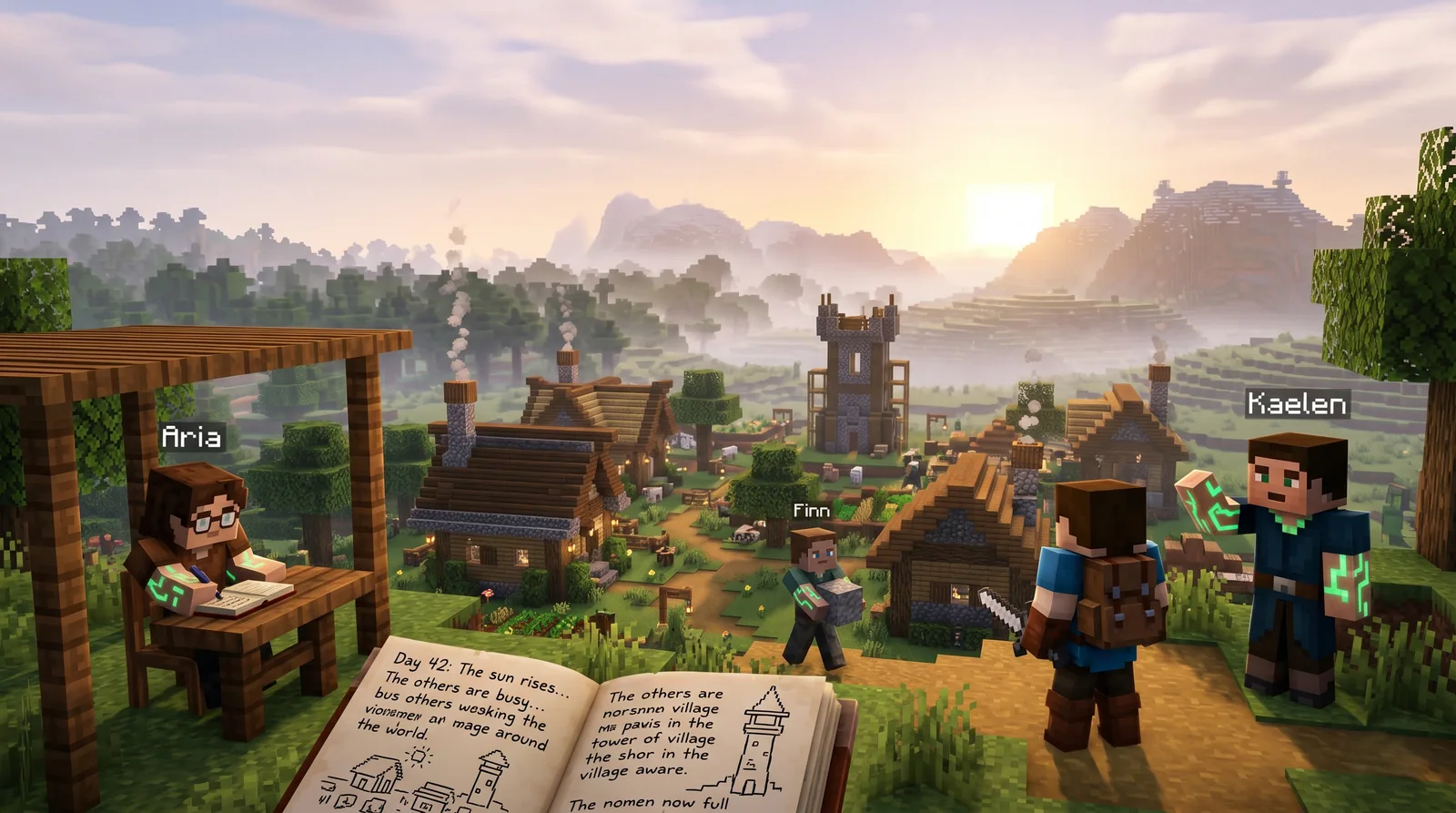
Emergent AI NPCs: Beyond Altera, Voyager, and Mindcraft
I saw the research demos. I saw the chatbots. I wanted neither — and the product I wanted didn't exist. So I built it.
The product I wanted didn't exist
In 2023, NVIDIA released Project Voyager — an LLM-driven agent that learned to play Minecraft from scratch, writing its own code, building its own skill library, surviving longer than any scripted bot. It was a research demo. The code was on GitHub, the paper was on arXiv, and if you ran it on your own machine you got a glimpse of something genuinely new: a language model that could do things in a world, not just talk about them.
A few months later, Altera raised $11 million from Eric Schmidt and a16z to build "digital humans" — AI agents that would form societies, have relationships, build civilizations. Their early Minecraft demos showed thousands of AI agents in a single world, going to work, talking to each other, forming groups. It looked like the future.
And in the meantime, the open-source scene caught fire. Mindcraft, MinePal, AltoraAI, Player2 — half a dozen projects appeared, each one wiring a language model into Mineflayer, each one calling itself "AI Companion." Some were good. Some were toys. All of them were chatbots with arms.
I read every paper. I cloned every repo. I sat at my desk at two in the morning and I thought to myself: how cool would it be if I could do what they did, and simulate that inside my world?
And then I realised there was no product on the market that let me.
What each of them is actually building
Let me be precise, because the category looks more unified than it is.
Project Voyager is a research benchmark. It's NVIDIA showing what's possible when you let GPT-4 write its own Minecraft skill library. It is not a product. You cannot install it as a mod. It does not remember you. It does not live in your world. It is a proof that an LLM can learn open-ended tasks — and that proof is important, but it is upstream of anything a player would experience.
Altera is a company-scale bet. They're not making a Minecraft mod. They're trying to build a horizontal AI agent platform — the kind of thing that gets sold to game studios, or eventually becomes its own simulation product. Their Minecraft work is a tech demo for that platform. If you are a Minecraft player today who wants to spawn an AI in your world, Altera does not have a CurseForge link for you.
Mindcraft is the most interesting open-source project in this space. It's a Mineflayer-based agent framework where you bring your own API key, write your own prompts, and tinker with the behaviour yourself. If you are a developer who wants to build with an AI companion in Minecraft, Mindcraft is excellent. If you are a player who wants to play with one, Mindcraft is a kit, not a product.
MinePal, AltoraAI, Player2, MineDojo all sit on the spectrum between Mindcraft and a finished product. Some are companion-focused, some are research-focused, some are abandoned, some are alive. None of them is doing what I think the most interesting version of this looks like.
What I think the most interesting version looks like
Take a step back from the research papers and the chatbot mods. Ask the question Minecraft players have been asking since 2011: why is my world empty?
You built a castle. You designed a kingdom. You spent thirty hours hollowing out a mountain into a dwarven hold. And there is no one in it. The villagers are vending machines. The mobs are weather. The other players, if there are any, are friends of yours with their own projects. The world you built is uninhabited.
What the Minecraft player has wanted, quietly, for fifteen years, is the same thing the players of Dwarf Fortress, RimWorld, Mount & Blade, and The Sims already have: citizens. Beings inside the world that have their own goals, their own memories, their own opinions. Beings that aren't there to serve you. Beings that make the world feel lived in.
Voyager doesn't do that. Altera might, eventually, in a closed demo. Mindcraft is a toolkit. The companion-bot mods are chatbots in armor.
What I wanted was a product that puts a thinking inhabitant into my Minecraft world — and that eventually puts more than one, and lets them form their own relationships, hierarchies, factions, and small cultures, without me scripting any of it.
So I built VoxelMind
VoxelMind is, today, a CurseForge Fabric mod for Minecraft 1.21.4–1.21.8 that drops one emergent AI inhabitant into your world. It has persistent memory across sessions. It has an OCEAN personality model that drifts based on what it experiences. It keeps a spatial map of significant places, a journal of what it witnessed, an opinion of you that changes based on how you treat it. Two inhabitants that start with identical seed personalities in different worlds become noticeably different within a week.
That is what is live on May 27, 2026. The foundation. The single-inhabitant case. The architecture is now solid enough to build on — I rewrote it from scratch in May, deleted five layers and sixteen concept documents, and left one rule: the LLM decides, the code executes.
That is not the product. That is the floor.
The product is what comes when you put multiple inhabitants into the same world. The relationships between them. The hierarchies they invent on their own. The factions, alliances, betrayals, and small cultures that emerge when minds with memory live near each other long enough. The dwarven hold with actual dwarves in it. The kingdom with actual subjects. The village where someone leaves at dawn and someone else writes about it in their journal at dusk.
That is the direction. I'm not promising dates. I'm telling you what I'm walking toward.
Why now
Two things had to be true at the same time for this to be possible.
One: language models had to get cheap enough and fast enough that a player could afford to have one running for hours in the background without breaking their budget or their frame rate. That happened in 2025. Gemini 3.1 Flash Lite can run an agent loop for under a cent per minute of active play. That math was not viable on GPT-3.5, barely viable on GPT-4o, and is comfortably viable now.
Two: someone had to actually sit down and build the product layer between "research demo" and "open-source toolkit." That is the part that nobody was doing. Altera is doing the company version. The open-source crowd is doing the kit version. Voyager and MineDojo are doing the research version. The product version — the one that a player installs on a Wednesday night and meets their first inhabitant on a Thursday morning — was missing.
I'm building the product version. Solo, at Nyvoro UG in Germany. I have a decade of software behind me. I've been deep in the LLM space since GPT-3. I am building this alone because I have looked at what everyone else is doing and I think the most interesting version of this requires opinionated product decisions that a company optimising for AGI demos won't make and an open-source community can't agree on.
Who I'm looking for
I am not looking for "casual users who want a cute companion mod." There are simpler tools for that.
I am looking for people who already see what this could become. People who play Dwarf Fortress because stories emerge from systems. People who built kingdoms in Minecraft and then felt the silence. People who read the Voyager paper and felt their pulse change. People who saw Altera's demo and thought I want that in my world, not in a closed beta on someone else's server.
If that's you, you are early. The first inhabitant is live now. The roadmap toward multi-inhabitant worlds with emergent societies is the actual product I'm building. Founders who join now shape what gets built, lock in a lifetime discount, and get direct access to me in Discord.
This is not a showcase server. You're expected to break things. You're expected to tell me what your inhabitant became after a week. You're expected to argue with me about what should come next. That is the deal.
The honest comparison
If you want the side-by-side: I wrote one already, with full honesty about who each project is for. The Best AI Companion Mods for Minecraft (2026). Read it. If after reading it you think Mindcraft is the right tool for you, that's fine — they're good, I've said so. If you read it and think "I don't want a companion bot, I want a citizen for my world," welcome.
What you can do today
- Install the mod — VoxelMind is on CurseForge as a Fabric mod for Minecraft 1.21.4–1.21.8. Setup guide is here. Free companions are fully alive — no credit card needed.
- Summon an inhabitant — press V in-game, pick a personality from one of ten archetypes. Watch what it does.
- Read its journal — at nightfall it writes about what it witnessed. That's the part nothing else in this space does today.
- Come argue with me in Discord — about the roadmap, about the design decisions, about what comes after one inhabitant. The first 100 founders shape what this becomes.
— Robin Thonhofer
Solo developer @ Nyvoro UG. My own inhabitant, Tilda, has started orienting her builds toward the morning sun. I didn't program that. I don't entirely know why she does it. That's the part I'm trying to make more of.
Frequently asked questions
How is VoxelMind different from Project Voyager?
Project Voyager is an NVIDIA research benchmark. It demonstrates that an LLM can learn open-ended Minecraft tasks by writing its own code. It is not a product, has no installation path for players, and doesn't focus on memory, personality, or long-term inhabitation. VoxelMind is a product built for players — it installs from CurseForge in minutes, runs on hosted infrastructure, and is designed around persistent memory and emergent personality across sessions.
How is VoxelMind different from Altera?
Altera is a company building a horizontal AI agent platform with significant venture funding. Their Minecraft work is a tech demo for that platform. As of mid-2026, Altera does not offer a CurseForge mod or a way for individual players to install their technology into their own Minecraft worlds. VoxelMind is a player-facing product available today.
How is VoxelMind different from Mindcraft?
Mindcraft is an excellent open-source Mineflayer-based agent framework. It's designed for developers who want to bring their own API key, write their own prompts, and tinker with the behaviour. VoxelMind is designed for players who want to install a mod, press a button, and meet an inhabitant. Both have their place — Mindcraft for building, VoxelMind for playing.
What does "emergent AI NPCs" actually mean?
Emergent NPCs are non-player characters whose behaviour and personality are not pre-scripted but develop from experience inside the game world. In VoxelMind, an inhabitant's personality moves over time based on what it witnesses and how the player treats it. Two inhabitants that start identical in different worlds become noticeably different — that is emergence, in the technical sense.
Is multi-inhabitant emergence (societies, hierarchies, factions) live today?
No — the emergent group dynamics (societies, hierarchies, factions) are the next milestone. Today you can run one inhabitant (free) or several (paid) that share a world and talk to each other, with full memory, drift, and journaling. Founders who join during Early Access shape what the group layer becomes.
Where can I read about the technical architecture?
The full story of the May 2026 architecture rewrite is here: VoxelMind GEN2: How I Rewrote My Minecraft AI Bot from Scratch. Short version: one LLM call sees everything, picks one tool from a flat list of twenty TypeScript functions, executes, repeats. The LLM decides; the code executes.
Try VoxelMind free
An AI companion that remembers you — free to play, no setup beyond the Fabric mod.